The global adhesive and sealant market is growing fast in 2026, pulled along by construction activity, automotive lightweighting, electronics assembly, and e-commerce packaging. Raw material teams are under constant pressure to cut costs without sacrificing formulation performance. Borax pentahydrate (Na2B4O7 x 5H2O), a sodium borate compound with a high boron content relative to its weight, keeps showing up on approved ingredient lists across all these sectors.
This article covers the technical, commercial, and regulatory reasons manufacturers are buying it, and what that means for procurement and R&D teams planning their 2026 supply strategies.
What Is Borax Pentahydrate?
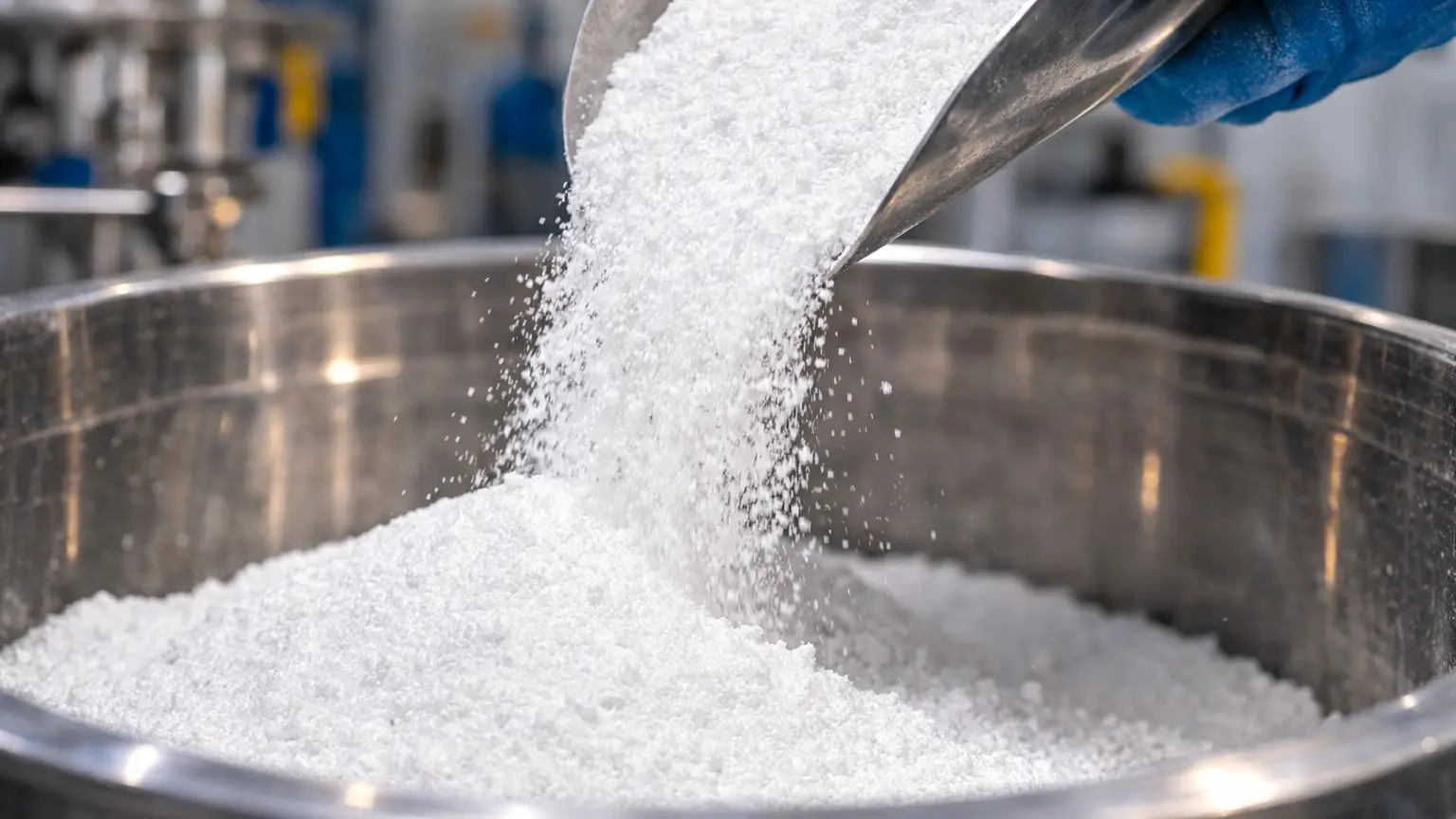
Borax pentahydrate is a partially hydrated sodium borate with five water molecules per formula unit, sitting between the anhydrous form and the more common decahydrate (borax decahydrate, with ten water molecules). It comes as a white, free-flowing powder with a molecular weight of approximately 291.3 g/mol and a boron oxide (B2O3) content of around 48.8%.
That higher B2O3 content is the main reason manufacturers prefer it over decahydrate for industrial use. Less water means more active boron per kilogram shipped and stored. It also handles better in humid warehouse conditions, where decahydrate can cake or absorb moisture unevenly. For continuous mixing lines where consistent feed rates matter, that stability is worth paying a small premium.
Core Technical Functions in Adhesives & Sealants
Cross-Linking Agent in PVA and Water-Based Systems
Borax pentahydrate's most established role is as a cross-linker in polyvinyl alcohol (PVA)-based adhesives. Borate ions react with the hydroxyl groups on PVA chains to form reversible di-diol complexes, which raises viscosity, cohesive strength, and tack. Wood adhesives, packaging glues, and paper converting products all use this mechanism.
Water-based adhesive systems have been displacing solvent-based ones for years under VOC regulations, and that shift has increased demand for effective aqueous cross-linkers. What makes borax useful here is that the cross-linking reaction responds to pH. Formulators can control open time and bond strength by adjusting alkalinity, and the network is reversible on dilution, which matters for products like remoistenable labels or water-reactivated envelope seals.
Buffering and pH Stabilization
Added to an aqueous adhesive system, borax pentahydrate holds pH in the mildly alkaline range, typically 8.5 to 9.5. That range matters for several reasons. Preservatives used in water-based adhesives are most effective above pH 7, and many lose activity in acidic conditions. Emulsion stability also depends on pH: if the system drifts acidic, polymer particles can coagulate and the batch is lost. Bio-based adhesives using enzyme-modified starch or protein components are especially sensitive to pH shifts.
Flame Retardancy
When heated, borax pentahydrate releases its water and then fuses into a glassy borate layer that slows combustion and insulates the substrate underneath. This makes it a functional ingredient in intumescent sealants, firestop compounds, and passive fire protection products used around cable penetrations, pipe sleeves, and expansion joints in construction.
Fire safety codes in the EU, North America, and across Asia-Pacific have tightened over the past decade, and construction sealant manufacturers face growing pressure to demonstrate compliance without relying on halogenated flame retardants. Several halogenated chemistries are now restricted under RoHS and similar frameworks, and borax-based systems are one of the cleaner alternatives available at scale.
Rheology Modification
Borax pentahydrate also affects the flow behavior of sealant formulations. At the right concentration, it produces thixotropy: the sealant flows under shear during application but resists sagging once placed on a vertical surface or overhead. Gun-grade and cartridge-applied sealants need this property to work reliably in the field. Adjusting borax loading lets formulators tune the sag resistance and working time without changing the base polymer system.
Preservation and Antimicrobial Properties
Borate ions interfere with microbial metabolism, which gives borax-containing formulations some resistance to mold and bacterial growth during storage and in service. For products used in humid environments (bathroom sealants, roofing adhesives, marine applications), this can reduce or eliminate the need for a separate biocide package. Fewer additives means a simpler formulation to register and a lower risk of biocide interactions affecting cure or adhesion.
Supply Chain and Economic Drivers in 2026
Cost Efficiency vs. Decahydrate
The cost argument for pentahydrate over decahydrate comes down to boron yield. Decahydrate is about 36% B2O3 by weight; pentahydrate is around 48.8%. That 35% difference in boron density affects every step from freight to warehouse footprint to batch size. A plant running 500 kg adhesive batches that switches from decahydrate to pentahydrate at equivalent boron loading can reduce raw material inbound weight by roughly 25%, with corresponding savings on logistics and storage.
Tightening Supply of Alternative Cross-Linkers
Several cross-linkers commonly used in water-based adhesives have had availability problems in recent years. Zirconium ammonium carbonate and some titanate cross-linkers saw spot shortages during 2022 to 2024 as specialty chemical supply chains tightened. Borax pentahydrate has been less affected because global borate production is concentrated in a small number of large, long-operating mines: primarily Eti Maden's operations in Turkey and Rio Tinto Borates in California's Mojave Desert. Both run on long-term offtake contracts, which creates more predictable supply than toll-manufactured specialty chemicals.
Regulatory Tailwinds and Headwinds
Borax sits in a complicated regulatory position. Under REACH Regulation 1272/2008, sodium borate compounds are classified as reproductive toxicants (Category 1B), which restricts their use in consumer products above set concentration limits. That classification has caused reformulation in some consumer adhesive and sealant product lines sold in the EU.
For professional and industrial use, however, the restrictions are narrower. Most adhesive and sealant manufacturing falls outside the consumer product scope, and workplace exposure is managed through occupational health controls rather than substance bans. Manufacturers selling into regulated markets have generally responded by tightening formulation specs to keep borax concentrations below trigger thresholds, investing in engineering controls to meet occupational exposure limits, and documenting Safe Use Notes for downstream users.
Outside the EU, particularly in Southeast Asia, India, and Latin America, regulatory frameworks around borates are less restrictive, and industrial consumption continues to grow without the same compliance overhead.
Near-Shoring and Sourcing Geography
Supply chain near-shoring has reshaped how European adhesive manufacturers think about boron sourcing. Turkey holds the world's largest proven boron reserves and Eti Maden supplies a substantial share of European industrial demand. Several European distributors have built direct procurement relationships with Turkish producers, reducing transit times and improving lot consistency compared to spot purchasing through intermediaries. North American producers, meanwhile, benefit from domestic supply out of Boron, California, where Rio Tinto's operation has run continuously since 1956.
Application Sectors Driving Demand
Borax pentahydrate demand in adhesive and sealant manufacturing is growing across several end markets at once:
- Construction and infrastructure: High-performance tile adhesives, grouts, and fire-rated joint sealants all draw on borate chemistry. Urbanization in Southeast Asia and post-pandemic renovation spending in North America and Europe are both pushing volume.
- Packaging: Corrugated board and carton adhesives that use borax-cross-linked starch and PVA systems are under reformulation pressure as brands pursue recyclable, bio-based packaging. Borax helps these systems hit performance specs with lower polymer content.
- Automotive: Structural adhesives used in lightweight composite assemblies need thermal stability and resistance to humidity. Borate chemistry contributes to both, and EV platform assembly has opened new bonding applications in battery enclosures and thermal management components.
- Electronics: Conformal coatings and encapsulants for PCBs and power electronics use borax-containing formulations for flame retardancy and dielectric stability. Demand here is growing with EV battery manufacturing and consumer electronics production in Southeast Asia.
- Woodworking and furniture: In markets with strict limits on formaldehyde emissions from panel products, PVA-borax systems are a practical alternative to UF resin-based adhesives, particularly for interior furniture and cabinetry.
Sustainability Considerations
Borax pentahydrate's sustainability profile is mixed, and manufacturers should assess it honestly rather than defaulting to a simple positive or negative verdict.
The concerns are real. Borate mining is energy-intensive, and the REACH reproductive toxicity classification reflects genuine hazard data. Occupational exposure during manufacturing requires proper controls, and consumer product restrictions exist for legitimate reasons.
At the same time, borax enables waterborne adhesive formulations that replace solvent-based systems with far higher VOC loads. Its flame retardant function reduces reliance on halogenated additives, which have worse environmental persistence profiles. Boron is a naturally occurring element and does not bioaccumulate through food chains the way some synthetic organic additives do.
Several industry groups are working with EU regulators in 2026 to refine the risk assessments that underpin the REACH classification, specifically to distinguish between industrial process exposure and consumer product exposure. The outcome will affect whether current concentration limits stay, tighten, or are revised for specific use categories.
Sourcing Best Practices for 2026
Adhesive and sealant manufacturers buying borax pentahydrate in volume should address a few common sourcing gaps:
Qualify at least two suppliers. Single-source arrangements on a material this tightly mined create unnecessary exposure to regional disruptions or force majeure events at producer sites.
- Specify particle size distribution and B2O3 content in purchase orders. Commercial grades vary, and inconsistent particle size affects dissolution rate and cross-link density in PVA systems.
- Compare decahydrate and pentahydrate on a boron-equivalent cost basis, not unit price. When freight and storage costs are included, pentahydrate is often cheaper per unit of B2O3 delivered, even when its per-tonne price is higher.
- Track REACH authorizations and OSHA PEL updates for sodium borates. The regulatory picture is active in 2026, and compliance teams need current information before reformulating products or entering new markets.
- Run formulation optimization trials with technical support from your borate supplier. Many manufacturers are using more borax than necessary; reducing loading while maintaining performance lowers both cost and regulatory exposure.
Conclusion
Borax pentahydrate's continued presence on adhesive and sealant formulation sheets comes down to a straightforward value equation: it does several useful things at once, it is available from stable supply sources, and nothing has emerged to fully replace it at comparable cost.
The regulatory situation in the EU requires active management, and manufacturers selling consumer products in those markets have had to reformulate carefully. For industrial and professional applications, the material remains accessible and the compliance pathway is clear. In markets outside the EU, the commercial case is more straightforward still.
What will change the picture is if the REACH review process in 2026 leads to tighter industrial use restrictions, or if a commercially viable boron-free cross-linking system reaches the market at scale. Neither looks imminent. For now, procurement teams who understand the supply geography and formulators who know the chemistry will keep borax pentahydrate in active use.
Leave a Comment