Introduction
Soya lecithin safety, storage, and handling practices play a critical role in maintaining product quality across food, nutraceutical, feed, and industrial manufacturing sectors. Widely used in chocolate, bakery products, dairy alternatives, animal feed, pharmaceuticals, and dietary supplements, soya lecithin is valued for its emulsifying, stabilizing, and nutritional properties. While its functionality is well understood, improper storage or handling can quickly compromise performance, shelf life, and regulatory compliance.
For procurement managers, quality assurance teams, logistics providers, and production engineers, standardized handling procedures are essential. Correct management helps prevent oxidation, moisture absorption, contamination, and physical degradation while ensuring alignment with global safety regulations. This article outlines best practices for soya lecithin safety, storage, and handling to support consistent performance from warehouse to final application.
What Is Soya Lecithin?
Soya lecithin is derived from soybeans during soybean oil refining. Production typically begins with solvent extraction of oil using food-grade hexane, followed by degumming, hydration, centrifugation, and purification. The final product contains a complex mixture of phospholipids, including phosphatidylcholine, phosphatidylethanolamine, and phosphatidylinositol, along with glycolipids, triglycerides, and trace fatty acids.
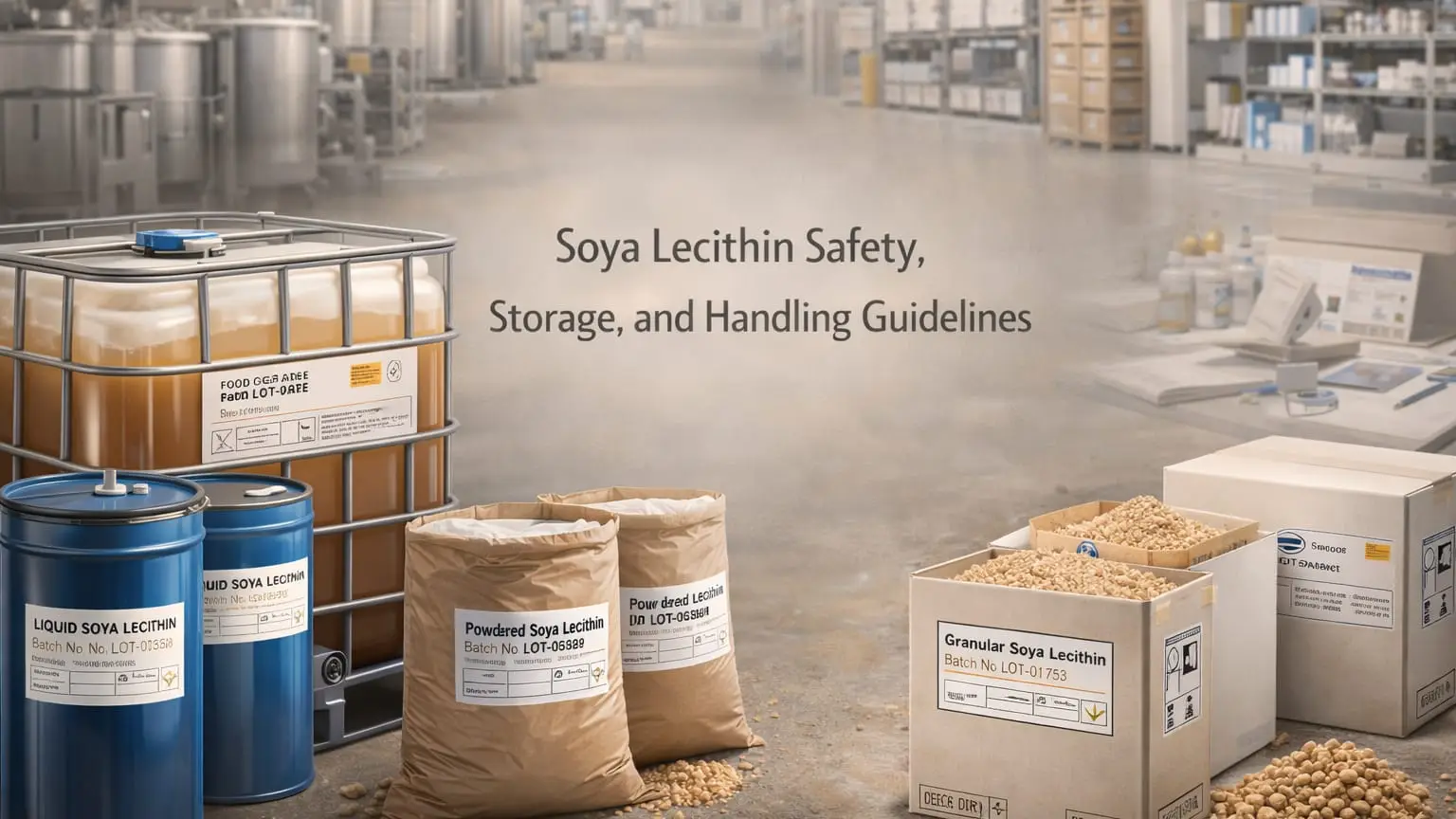
Commercially, soya lecithin is available in liquid, powdered, and granular forms. Standard lecithin retains a higher proportion of neutral oil, while refined or de-oiled grades offer increased phospholipid concentration, reduced odor, and improved flowability. These variations allow manufacturers to select lecithin grades suitable for food processing, animal feed, nutraceutical formulations, and industrial applications.
Safety Profile of Soya Lecithin
Soya lecithin has a long history of safe use. It is classified as Generally Recognized as Safe by the U.S. Food and Drug Administration under 21 CFR 184.1400 and approved in the European Union as food additive E322. When used within approved limits, it presents low toxicological risk in both food and feed applications.
The primary safety consideration involves soy allergens. Although refined soya lecithin typically contains minimal residual soy protein, often below 30 parts per million, allergen labeling remains mandatory under regulations such as the U.S. Food Allergen Labeling and Consumer Protection Act and EU Regulation 1169/2011. Accurate labeling and traceability are therefore essential.
In occupational environments, powdered or granular lecithin may generate dust. This can cause mild eye, skin, or respiratory irritation if not properly controlled. Dust accumulation also presents a combustible dust risk under certain conditions. Adequate ventilation, dust extraction, and adherence to supplier Safety Data Sheets reduce these risks.
Regulatory and Compliance Requirements
Soya lecithin complies with food and feed regulations in major global markets. In the United States, it follows FDA food additive regulations. In the European Union, it aligns with European Food Safety Authority guidance. In Asia-Pacific regions such as Indonesia and China, it meets national standards including BPOM RI and GB 2760.
Regulatory compliance typically includes allergen declarations, batch identification, country-of-origin documentation, and integration into food safety systems such as HACCP, GMP, and FSSC 22000. Certificates of Analysis and Safety Data Sheets provided by suppliers confirm key quality parameters, including heavy metal limits, solvent residues, moisture levels, and peroxide values. These documents are essential for audits, imports, and quality assurance.
Storage Guidelines for Soya Lecithin
Storage Conditions
Controlled storage conditions are essential for maintaining lecithin stability. Recommended storage temperatures range between 15°C and 25°C for both liquid and powdered forms. Temperatures above 30°C accelerate oxidation and viscosity changes, while excessive cooling can lead to thickening or phase separation in liquid lecithin.
Storage areas should be dry, well ventilated, and protected from direct light. Relative humidity should remain below 60 percent, as moisture accelerates degradation and can cause caking in powdered lecithin. Oxygen, heat, and humidity are the primary factors affecting shelf life and must be minimized.
Shelf Life and Packaging
Shelf life depends on product form and storage conditions. Liquid soya lecithin typically remains stable for 12 to 24 months, while powdered or granular lecithin can maintain quality for 18 to 36 months when properly stored.
Packaging is a key factor in preservation. Liquid lecithin is commonly stored in food-grade HDPE drums, intermediate bulk containers, or lined steel tanks, often with nitrogen blanketing to limit oxidation. Powdered lecithin is packed in multi-layer paper bags or lined cartons with moisture barriers. First-in, first-out inventory management helps prevent quality loss due to aging.
Handling Guidelines and Best Practices
Safe handling procedures protect both product quality and worker safety. During weighing, transfer, and dosing operations, enclosed systems or localized dust extraction should be used to reduce airborne particles. Personal protective equipment such as gloves, safety goggles, protective clothing, and N95-rated dust masks is recommended when handling powdered lecithin.
Spills should be contained immediately using absorbent materials. Dry sweeping should be avoided, as it increases dust dispersion. Cleaning and disposal must follow local environmental regulations. Cross-contamination risks can be reduced by dedicating equipment or implementing validated cleaning procedures using approved solvents.
In processing environments, lecithin should be introduced under controlled conditions. Powdered lecithin often performs best when pre-dispersed in oil or liquid systems before full incorporation. Gentle mixing improves activation of emulsifying properties while reducing air incorporation and oxidative stress.
Transportation and Logistics Considerations
Maintaining product integrity during transportation is essential. Containers should be sealed with tamper-evident closures and clearly labeled with product grade, allergen information, and handling instructions. For shipments longer than 48 hours or those passing through warm climates, insulated or temperature-controlled transport is recommended.
For international logistics, soya lecithin is classified as non-hazardous and shipped under the proper shipping name “Lecithin.” While not regulated as a dangerous good, best practices include humidity control, temperature monitoring, and careful loading to prevent packaging damage or contamination.
Quality Control and Risk Management
Robust quality control systems support consistent lecithin performance. Incoming material inspections typically assess color, odor, viscosity, moisture content, acid value, and peroxide value using recognized analytical methods such as AOCS standards. Rancid odor, excessive darkening, or abnormal viscosity often indicate oxidation or degradation.
Batch traceability, supplier audits, and periodic laboratory testing help reduce rejection rates and prevent supply disruptions. These practices are particularly important for manufacturers supplying regulated food, nutraceutical, and export markets.
Industry Applications and Benefits
Soya lecithin’s performance across food, feed, nutraceutical, and industrial applications depends heavily on proper safety and handling practices. In chocolate and bakery products, it supports stable emulsions and consistent texture. In animal feed and supplements, it improves nutrient delivery and bioavailability. In industrial uses, it functions reliably as a dispersant, release agent, and processing aid.
Consistent quality achieved through correct storage and handling protects formulation integrity, supports clean-label positioning, and safeguards brand reputation. Partnering with experienced global suppliers such as Chemtradeasia ensures access to compliant, traceable, and technically supported lecithin solutions.
Conclusion
Effective management of soya lecithin extends beyond sourcing and formulation. Safety, storage, handling, and logistics form a connected framework that preserves quality, extends shelf life, and ensures regulatory compliance. By implementing standardized protocols and working with reliable suppliers, manufacturers reduce risk while maximizing the functional and commercial value of this versatile ingredient.
For organizations operating in competitive global markets, disciplined lecithin management supports operational efficiency, consistent product performance, and long-term business success.
Leave a Comment