Introduction
Growing demand for clean-label products, sustainable sourcing, and functional natural ingredients has pushed soya lecithin into a central role across many industries. Derived from soybeans, this light yellow to brownish viscous material is widely used in food and beverage manufacturing, pharmaceuticals, cosmetics, animal nutrition, and industrial processing. Its plant-based origin, multifunctional performance, and compatibility with modern formulation requirements make it one of the most versatile bio-based additives available today.
As global manufacturers seek alternatives to synthetic emulsifiers and processing aids, soya lecithin continues to gain traction. Market expansion is driven by increasing consumption of processed foods, rising interest in plant-based formulations, and ongoing innovation in pharmaceutical and personal care products. For formulators and procurement teams, understanding how soya lecithin functions, where it performs best, and how to source consistent quality has become increasingly important.
What Is Soya Lecithin?
Soya lecithin is a naturally occurring mixture of phospholipids, neutral lipids, and minor components obtained during soybean oil processing. The primary functional components include phosphatidylcholine, phosphatidylinositol, and phosphatidylethanolamine. These compounds give lecithin its distinctive surface-active behavior.
Its molecular structure contains both water-attracting and fat-attracting groups, allowing it to interact with oil and water simultaneously. This dual affinity enables lecithin to stabilize emulsions, disperse powders, and improve texture in formulations that would otherwise separate or behave inconsistently.
Although lecithin was first identified in egg yolk, soybeans have become the dominant commercial source due to global availability, cost efficiency, and supply stability. The scale of the soybean industry ensures reliable production volumes and consistent quality across markets.
Key Functional Properties
Soya lecithin is valued for a combination of technical functions rather than a single role, which explains its widespread use across industries.
One of its most important properties is emulsification. Lecithin helps stabilize oil and water systems, supporting uniform texture and appearance in products such as sauces, dressings, chocolate, and margarine.
It also acts as a wetting and dispersing agent. In powdered formulations, lecithin improves the ability of solids to integrate smoothly into liquids, reducing clumping and improving processing efficiency.
In manufacturing environments, lecithin provides lubrication. It lowers stickiness and viscosity during mixing, extrusion, coating, and molding operations, helping improve throughput and reduce equipment wear.
Lecithin also contributes to oxidative stability. While it is not a primary antioxidant, it can support fat stability by slowing oxidation in lipid-rich systems, which helps extend shelf life.
Forms of Soya Lecithin
Soya lecithin is available in several forms to meet different formulation needs.
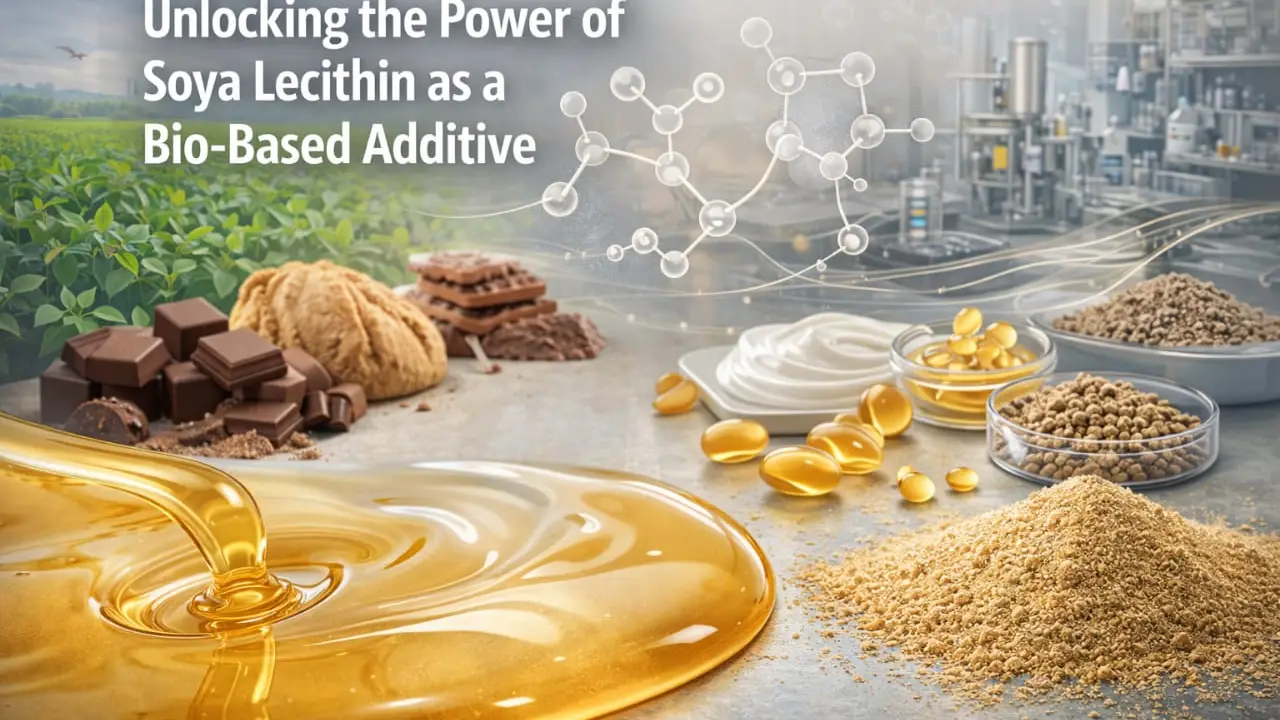
Liquid lecithin is the most commonly used form. Its viscous nature makes it easy to blend into liquid systems and fat-based formulations. It is widely used in food processing, especially in bakery, confectionery, and beverage applications.
De-oiled lecithin is produced by removing most of the oil content, resulting in a powder with higher phospholipid concentration. This form is preferred in dry mixes, dietary supplements, and applications where flowability and low fat content are required.
Granulated and fractionated lecithins offer higher purity or targeted phospholipid profiles. These grades are often used in pharmaceutical, nutraceutical, and specialty cosmetic formulations where performance consistency and bioavailability are critical.
Applications Across Industries
Food and Beverage
The food and beverage industry represents the largest share of global soya lecithin consumption. Lecithin plays a key role in improving texture, processing efficiency, and product stability.
In chocolate and confectionery, lecithin reduces viscosity, improves flow, and enhances mouthfeel. In bakery products, it supports dough conditioning, improves volume, and helps retain moisture, extending freshness. Lecithin also stabilizes emulsions in sauces, spreads, and dressings and enables rapid dispersion in instant beverages, soups, and powdered mixes.
Pharmaceuticals and Nutraceuticals
In pharmaceutical and supplement formulations, soya lecithin serves as an emulsifier and stabilizer in oral and topical products. It is also widely used in liposomal delivery systems, where phospholipids encapsulate active ingredients. This approach improves solubility and bioavailability, particularly for fat-soluble vitamins and bioactive compounds.
Cosmetics and Personal Care
Lecithin is commonly used in creams, lotions, and serums due to its emulsifying and skin-conditioning properties. It contributes to smooth texture, uniform dispersion of active ingredients, and improved skin hydration. Its natural origin also aligns well with clean beauty trends.
Industrial and Feed Applications
Beyond consumer products, soya lecithin is used in paints and coatings as a dispersing agent, in textile processing as a lubricant, and in industrial formulations where surface activity is required.
In animal feed, lecithin supports fat utilization, improves pellet quality, and enhances energy efficiency in certain formulations. These functional benefits are particularly relevant in poultry and aquaculture feeds.
Sustainability and Market Trends
The global soy lecithin market continues to grow steadily, supported by rising demand across food, health, and industrial sectors. Market projections indicate strong long-term expansion driven by clean-label preferences and plant-based formulation strategies.
Sustainability plays a central role in lecithin’s appeal. As a by-product of soybean oil refining, lecithin aligns with resource efficiency and circular economy principles. Compared with many synthetic emulsifiers, it offers a renewable and widely accepted alternative.
Liquid lecithin remains the dominant form due to ease of handling, while powdered and specialty fractions are experiencing faster growth in nutraceutical and health-focused applications.
Safety and Regulatory Status
Soya lecithin is widely recognized as safe for food and feed use and is approved by regulatory authorities in major markets. During digestion, lecithin breaks down into naturally occurring nutrients such as choline and fatty acids.
Although derived from soybeans, lecithin contains only trace levels of soy protein. Most individuals with soy sensitivity tolerate lecithin well, though labeling requirements vary by region and must be followed.
Sourcing and Quality Considerations
Performance consistency depends heavily on lecithin quality. Variations in soybean origin, extraction methods, and refining processes can influence phospholipid content, viscosity, and functional behavior.
Working with reliable suppliers helps ensure consistent specifications, proper documentation, and regulatory compliance. A global sourcing platform such as Chemtradeasia enables access to a broad range of lecithin grades, including food-grade liquids, de-oiled powders, and specialty fractions. Such partnerships simplify procurement, support formulation optimization, and ensure stable supply for both development and commercial-scale production.
Conclusion
Soya lecithin remains one of the most versatile and effective bio-based additives used in modern manufacturing. Its emulsifying, dispersing, and stabilizing properties support a wide range of applications, from food and beverages to pharmaceuticals, cosmetics, and industrial products.
As market growth continues to be driven by clean-label demand, sustainability priorities, and functional performance needs, soya lecithin will retain its position as a key formulation ingredient. For manufacturers seeking consistent quality and reliable supply, strategic sourcing through trusted partners such as Chemtradeasia plays an essential role in maintaining performance, compliance, and long-term competitiveness.
Leave a Comment