Introduction
Agar is one of the most historically significant hydrocolloids used in the global food, biotechnology, and pharmaceutical industries. Extracted from specific species of red seaweeds, agar functions as a powerful gelling agent capable of forming strong, stable gels at very low concentrations. These characteristics have made it indispensable in applications ranging from microbiological culture media and confectionery jellies to plant-based desserts and stabilizing systems in processed foods.
Despite its widespread use, the global agar supply chain begins far from food factories or laboratories. The production of agar relies on marine ecosystems where specific red seaweeds grow naturally or are cultivated in coastal aquaculture systems. Understanding how these marine raw materials are sourced is essential for manufacturers that depend on consistent hydrocolloid functionality.
Two primary sourcing pathways support the global agar industry. In some regions, agar-producing seaweeds are still harvested directly from natural marine environments through traditional wild collection practices. In other regions, coastal aquaculture systems cultivate red seaweed species specifically for industrial agar extraction.
These two sourcing strategies—wild harvest and coastal farming—represent fundamentally different approaches to managing marine resources. They influence not only the environmental footprint of agar production but also the structure and reliability of the global agar supply chain.
As demand for hydrocolloids continues to grow alongside plant-based foods, convenience products, and biotechnology applications, ingredient buyers are paying closer attention to agar sourcing practices. Procurement teams increasingly evaluate not only the functional quality of agar but also the sustainability and stability of the underlying seaweed supply networks.
This article examines the two primary sourcing systems that support the global agar industry. It explores how wild seaweed harvesting and coastal farming operate, the environmental considerations associated with each approach, and the procurement factors manufacturers should evaluate when navigating the modern agar supply chain.
Agar Raw Material Sources: Gelidium and Gracilaria Seaweeds
Agar is extracted primarily from certain species of red seaweed belonging to the genera Gelidium and Gracilaria. These marine macroalgae contain polysaccharides that form firm gels when dissolved in hot water and subsequently cooled. The resulting gel structures are known for their strength, clarity, and thermal stability, which explains why agar remains a cornerstone hydrocolloid in both food and scientific applications.
Among the two primary sources, Gelidium species are traditionally associated with higher gel strength and superior clarity. Agar derived from these seaweeds is therefore widely used in microbiological culture media and high-end food applications where gel transparency and firmness are critical. However, Gelidium grows relatively slowly in natural marine environments and has proven difficult to cultivate at large commercial scales.
Because of these biological limitations, Gelidium seaweed is typically harvested from wild coastal ecosystems rather than farmed through aquaculture systems. The dependence on natural marine beds has historically shaped part of the agar supply chain around traditional seaweed harvesting activities.
Gracilaria species, in contrast, are more adaptable to cultivation in coastal aquaculture systems. These seaweeds grow relatively quickly and tolerate a wider range of environmental conditions, making them suitable for large-scale farming operations. As a result, Gracilaria has become one of the most important raw materials supporting modern agar production.
Although agar extracted from Gracilaria may exhibit slightly lower gel strength compared with Gelidium-derived agar, advances in extraction technology have significantly improved its functional performance. Today, both seaweed sources play essential roles within the global agar raw material supply.
Wild Harvest Seaweed Supply Chains for Agar Production
Wild harvesting represents the traditional foundation of agar seaweed sourcing. In this system, coastal communities collect naturally growing red seaweed from intertidal zones or shallow offshore areas. Harvesting techniques vary depending on geography and species, but they generally involve manual collection during low tide or underwater gathering by divers.
Wild harvesting has historically been especially important for Gelidium species. These seaweeds attach firmly to rocky substrates in temperate marine environments, which makes artificial cultivation difficult. As a result, agar processors have long relied on natural seaweed beds to obtain the raw materials required for high-grade agar extraction.
Several coastal regions are well known for supplying wild Gelidium seaweed to the agar industry. Countries such as Spain, Portugal, Morocco, Japan, and Chile have historically produced significant volumes of wild-harvested red seaweed used in agar processing. Oceanographic conditions in these areas support the growth of dense natural seaweed populations.
Wild harvest supply chains often operate within regulatory frameworks designed to protect marine ecosystems. Governments may establish harvesting seasons, quotas, and permitted collection methods to prevent excessive extraction from natural seaweed beds. These policies aim to ensure that marine ecosystems can regenerate and continue supporting long-term agar production.
The economic structure of wild harvesting systems is typically decentralized. Independent collectors or small coastal cooperatives harvest seaweed and sell it to intermediaries or directly to processing facilities. While this structure supports local livelihoods, it can also introduce variability in raw material availability and quality within the agar supply chain.
Coastal Seaweed Farming for Agar Raw Material Supply
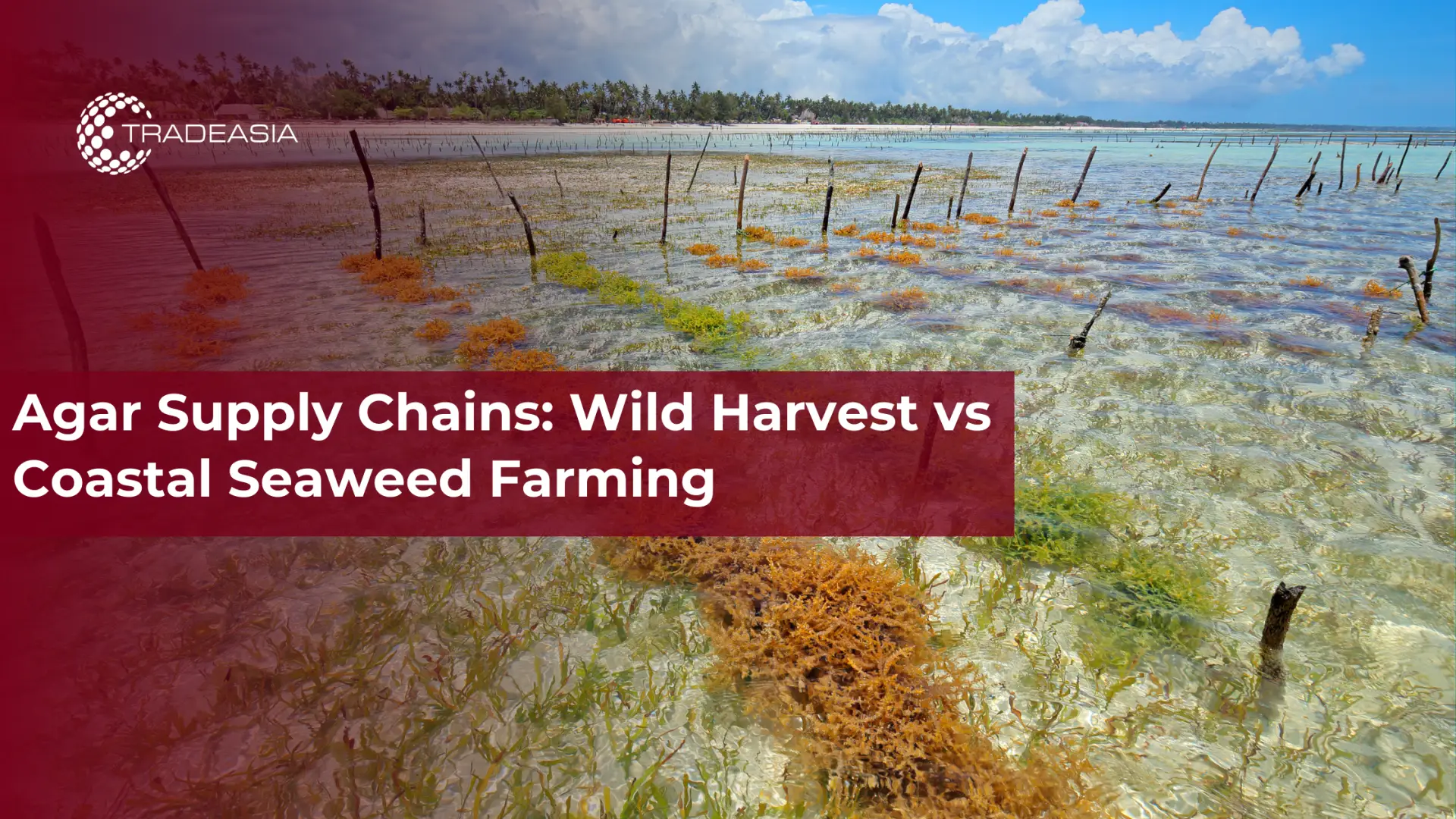
Over the past several decades, coastal aquaculture has emerged as a major alternative to wild harvesting within the agar supply chain. Seaweed farming involves cultivating red algae in controlled marine environments such as shallow coastal waters, lagoons, or nearshore aquaculture farms. Farmers typically propagate seaweed fragments on ropes or nets anchored in the water column.
Among agar-producing species, Gracilaria has proven particularly suitable for aquaculture systems. Its rapid growth rate and resilience to varying environmental conditions allow farmers to cultivate large volumes of biomass in relatively short periods. This biological advantage has encouraged many countries to invest in commercial seaweed farming industries.
Several nations have become major producers of farmed red seaweed used for agar extraction. Indonesia, China, Chile, and Vietnam are among the most prominent suppliers supporting the global agar raw material market. In these regions, seaweed farming contributes significantly to coastal economic development and export revenue.
Compared with wild harvesting, aquaculture systems offer greater predictability in production. Farmers can control planting cycles, harvesting schedules, and cultivation densities, allowing processors to plan raw material supply more reliably. In addition, selected seaweed strains can be cultivated to optimize agar yield and processing efficiency.
These advantages have contributed to the growing importance of farmed seaweed within the global agar supply chain. As demand for hydrocolloids continues to increase, aquaculture systems play an increasingly important role in stabilizing the supply of agar raw materials.
Environmental Impacts of Wild Seaweed Harvesting
Wild seaweed harvesting can provide important economic benefits for coastal communities while requiring relatively limited infrastructure. Because the activity relies on naturally occurring marine resources, it typically does not involve artificial structures or external nutrient inputs. When harvesting levels are properly managed, wild collection can coexist with marine biodiversity.
However, excessive harvesting pressure can damage natural seaweed beds and disrupt ecological balance. Seaweeds serve as important habitat structures within marine ecosystems, providing shelter for fish, invertebrates, and other organisms. If harvesting removes too much biomass from these ecosystems, the availability of habitat for marine life may decline.
Another environmental concern relates to harvesting techniques that remove entire seaweed plants. When collectors remove holdfast structures rather than trimming mature sections, the ability of seaweed populations to regenerate can be reduced. In areas where harvesting regulations are poorly enforced, these practices may contribute to long-term declines in natural seaweed resources.
Climate change also presents emerging challenges for wild seaweed supply chains. Rising ocean temperatures, changing currents, and coastal pollution can alter the distribution and productivity of natural seaweed beds. These environmental changes have already affected seaweed availability in several historically important harvesting regions.
Environmental Considerations in Seaweed Aquaculture
Seaweed aquaculture offers several environmental advantages compared with many other forms of marine farming. Unlike fish or shrimp aquaculture, seaweed cultivation does not require external feed inputs or antibiotics. Seaweeds absorb nutrients directly from surrounding seawater as they grow.
This biological characteristic allows seaweed farms to contribute positively to marine ecosystems in certain contexts. By absorbing dissolved nitrogen and phosphorus, cultivated seaweed can help reduce nutrient pollution and support improved coastal water quality.
However, large-scale aquaculture systems must still be carefully managed to avoid unintended ecological impacts. High-density farming structures may alter local water flow patterns or affect sediment movement in nearby habitats. These changes can influence the surrounding marine environment if cultivation is not properly regulated.
Another potential concern involves the introduction of non-native seaweed species into cultivation systems. If farmed species escape into surrounding ecosystems, they may compete with local marine vegetation. Responsible aquaculture practices therefore require environmental monitoring, appropriate stocking densities, and adherence to regulatory guidelines.
When properly managed, seaweed farming can represent one of the more environmentally sustainable forms of marine aquaculture. Its relatively low resource requirements make it an attractive component of future ocean-based food and ingredient production systems.
Agar Supply Chain Considerations for Ingredient Buyers
For food manufacturers and hydrocolloid buyers, understanding the structure of the agar supply chain is increasingly important. Different sourcing methods can influence both the functional characteristics of agar and the stability of raw material supply.
Wild-harvested seaweed often produces agar with exceptionally high gel strength, particularly when derived from Gelidium species. This characteristic makes wild-sourced agar valuable for specialized applications such as microbiological culture media and certain premium food products. However, the availability of wild seaweed can fluctuate due to environmental conditions and harvesting restrictions.
Seaweed aquaculture offers a more scalable and predictable supply of raw materials. Farmed Gracilaria can be harvested multiple times throughout the year, allowing processors to maintain steady production volumes. Although agar derived from cultivated seaweed may exhibit slightly different functional characteristics, modern extraction technologies have significantly improved its performance.
Ingredient buyers must therefore balance several procurement factors when selecting agar suppliers. These factors typically include gel strength requirements, supply stability, sustainability considerations, and long-term price dynamics. Companies that prioritize responsible sourcing practices often evaluate suppliers based on both environmental stewardship and supply chain transparency.
As sustainability reporting becomes more common in the food industry, visibility into agar seaweed sourcing practices may become increasingly important. Manufacturers seeking resilient and responsible supply networks are therefore paying closer attention to how agar raw materials are harvested or cultivated.
Conclusion
The global agar industry depends on a complex marine supply chain rooted in the harvesting and cultivation of red seaweeds. Two primary sourcing systems—traditional wild harvesting and modern coastal seaweed farming—have evolved to meet growing global demand for this versatile hydrocolloid.
Wild harvesting remains essential for sourcing high-quality Gelidium seaweeds, which provide exceptional gel strength for specialized applications. However, the limited availability of natural seaweed resources and environmental pressures have constrained the scalability of this sourcing model.
Coastal aquaculture has therefore become an increasingly important component of the global agar supply chain. Farming systems centered on Gracilaria species provide a more predictable and scalable source of raw materials for agar extraction. Advances in processing technology have further strengthened the role of cultivated seaweed within modern hydrocolloid production.
For ingredient buyers and food manufacturers, understanding these supply chain dynamics is essential for developing reliable sourcing strategies. By evaluating both environmental considerations and functional performance, companies can select agar suppliers that support long-term production stability and responsible resource management.
Partner with Food Additives Asia for Reliable Agar Supply
Consistent gel strength, clarity, and stability in agar applications depend heavily on the quality of the red seaweed raw materials used during extraction. At Food Additives Asia, we supply a portfolio of agar ingredients sourced from carefully selected producers that utilize both responsibly managed wild harvesting systems and well-regulated coastal seaweed farming operations.
Our sourcing approach focuses on working with processing facilities that maintain strong quality control standards and consistent production methods. This helps ensure reliable gel performance and stable product specifications across different batches of agar.
To support food manufacturers and formulation teams, we provide technical documentation including product specifications, analytical data, and supply chain information. These resources help customers evaluate ingredient suitability and integrate agar efficiently into food, confectionery, and plant-based product formulations.
If your organization is evaluating suppliers within the global agar supply chain, our team can provide additional product information and technical guidance. For specifications, sourcing inquiries, or supply availability, please visit foodadditivesasia.com and contact our team through the website.
Leave a Comment